How Google Map works and Dijkstra’s Algorithm
We are all confided in our houses and this is the perfect time to analyze the tool which we use for our daily commute, Google Maps.
If you open
the app now and see your general route, from Home to Work or Home to School ,
the travel time will be significantly less than the usual. Well this was
expected right? Less traffic , clear road.
But the way
it measures the “traffic” is more interesting.
The Shortest Route Problem
Observe
this maze below.

Computer can solve this problem easily by brute-force method. (i.e trying to connect S and F by trying all possible routes), But there are more than one solution to this problem.


Now the
question arises, how to reach from S to F as early as possible.
Travel time
doesn’t depend on Start or Finish points but the route chosen, So here we look
at Orange route and specifically a part of the orange route.

This part
of the route has 3 properties. A(Starting point), B(End point) and K (some
constant).
The Constant K
Now imagine
you are on a straight road, you have to reach from one end of that road to
other. Depending your speed is constant. What factors would determine the
travel time.
Generally
there are 2 factors, i) length of road
ii)
Roughness or Obstacles in the road.
Now you may
guess where we are going (no pun intended ).
We define
“K” value for each part of the route and
sum it up. After doing that we have Korange and Kblue .


Therefore
now we compare and Kblue and Korange , Which ever is low
that path is the shortest.
In google
maps, the value of K is variable and depends on the traffic and roughness of
the road.
The traffic is measured by number of active android devices in that area. Sattelite detects mobiles and their, if it detects a good amount of devices in stationary on that road, the K value for that route shoots up and it suggests you to take an alternate route.
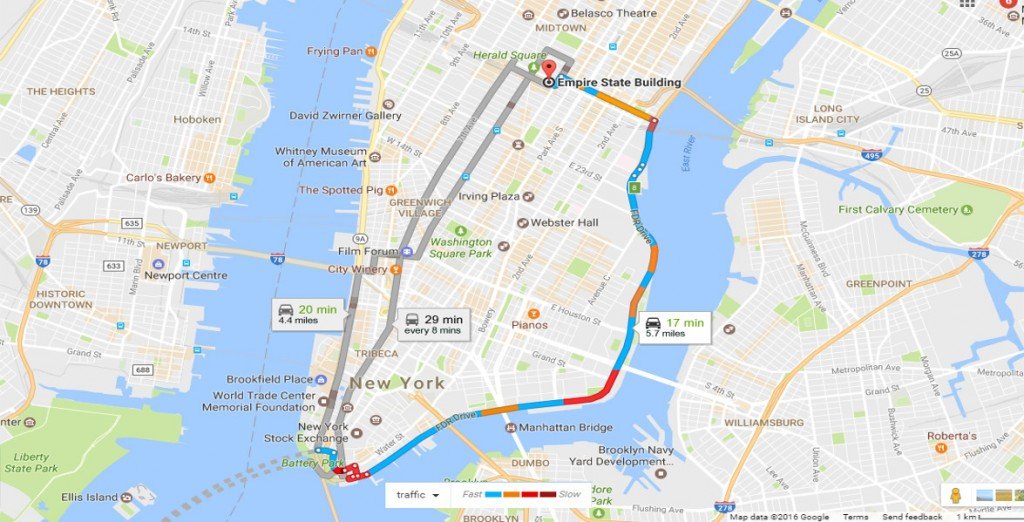
The other 2 routes may seem to be a faster route to the empire state building but as you can see thats not true.
and K values for Red marked road is higher than the one marked with blue, and this is constantly being updated in real time.
Djikstra’s
algorithm is not only by google maps but a lot of many services out there.


Comments
Post a Comment